
Read Time: 3 mins
Share This
The 24-hour news cycle didn’t just break the journalist; it broke the medium. We have reached a point where the sheer volume of information acts as a denial-of-service attack on human cognition. Agent Press isn’t just another chatbot wrapper; it’s a blueprint for a post-human editorial desk—a multi-agent system built to turn the “information deluge” into a scalable, low-cost asset. This is a structural shift in how we manufacture truth, moving away from manual synthesis toward a automated, high-velocity production line.
The Chain of Custody: Why Modular AI Wins
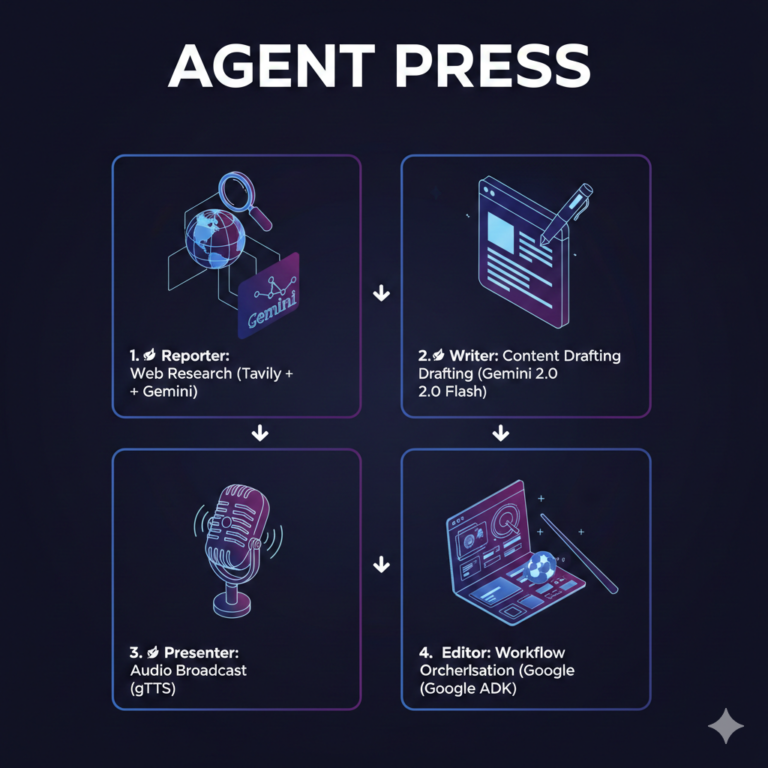
Standard LLM prompts suffer from “instruction fatigue” and “contextual drift”—the more you ask a single prompt to do, the lower the quality of the final output. Agent Press solves this by enforcing a strict “digital labor” division. It segments the workflow into four specialists: the Reporter, the Writer, the Presenter, and the Editor. This modularity ensures a high cost-to-content ratio, allowing for a streamlined production line where each agent excels at its specific micro-task without the dilution of a general-purpose prompt.
“An automated AI newsroom powered by Google Agent Development Kit”
The Reporter: Solving AI’s Truth Problem with DuckDuckGo
Hallucination is the “black lung” of the AI industry. Agent Press mitigates this by grounding the ‘Reporter’ agent in real-world Data via DuckDuckGo search integration. Instead of hallucinating a headline based on static training data, the agent scours the live web for real-time facts. By utilizing
pydantic for data validation, the system ensures that the Reporter’s findings are structured and verified before they ever reach the Writer’s desk. This isn’t just a search tool; it’s a factual security layer designed to ensure data integrity across the entire pipeline.The Presenter: Moving Beyond the Text-Box
In 2025, text is just the beginning. The ‘Presenter’ agent uses gTTS (Google Text-to-Speech) to turn synthesized research into broadcast-ready audio. We are witnessing the shift from AI as a “writing assistant” to AI as a “full-stack production house.” The strategic advantage is clear: one Python script can generate a blog post and a corresponding audio broadcast simultaneously. This transition from a draft to a “finished product” marks a significant milestone for agentic workflows, moving content from something you read to something you play.
The Editor: Governance as the New Orchestration
In the Agent Press architecture, the ‘Editor’ is far more than a spell-checker; it is the strategic brain housed within the
src/core package. While the implementation logic lives in src/agents, the core manages the planning, memory, and reasoning. This separation allows the Editor to act as a governance and risk-management layer. In an automated newsroom, the Editor is the orchestrator ensuring that the “chain of custody” remains unbroken, managing the workflow from the initial search to the final audio export.The High-Velocity Stack: Gemini 2.0 Flash & ‘uv’
To build a newsroom that keeps pace with reality, speed is the only metric that matters. Agent Press utilizes Google Gemini 2.0 Flash for low-latency inference and Python 3.12 managed by the
uv package manager. For a tech-literate audience, the choice of uv is a signal of intent: it is a lean, Rust-backed tool that eliminates the bloat of traditional dependency management. Combined with the “Flash” model, this stack is designed for a real-time environment where content needs to be live seconds after a news event breaks.The Roadmap to 2025
The Project is currently in “Phase 0″—the infrastructure and skeleton stage. The roadmap forward is a methodical climb toward full automation: moving from the “Reporter” web integration (Phase 1) and “Writer” drafting logic (Phase 2) to “Presenter” audio generation (Phase 3), and finally, full “Editor” orchestration (Phase 4). As we move toward the final implementation, a deeper question remains: when the reporter, the writer, and the news anchor are all effectively lines of code, what happens to the “human” element of the story? We are entering an era where the script doesn’t just describe the news—it creates it.
The Github Repo
https://github.com/Arif-Badhon/Multi_Agent_Press